AI Search
Who ChatGPT and Google's AI recommend in Wrexham and Chester, and why
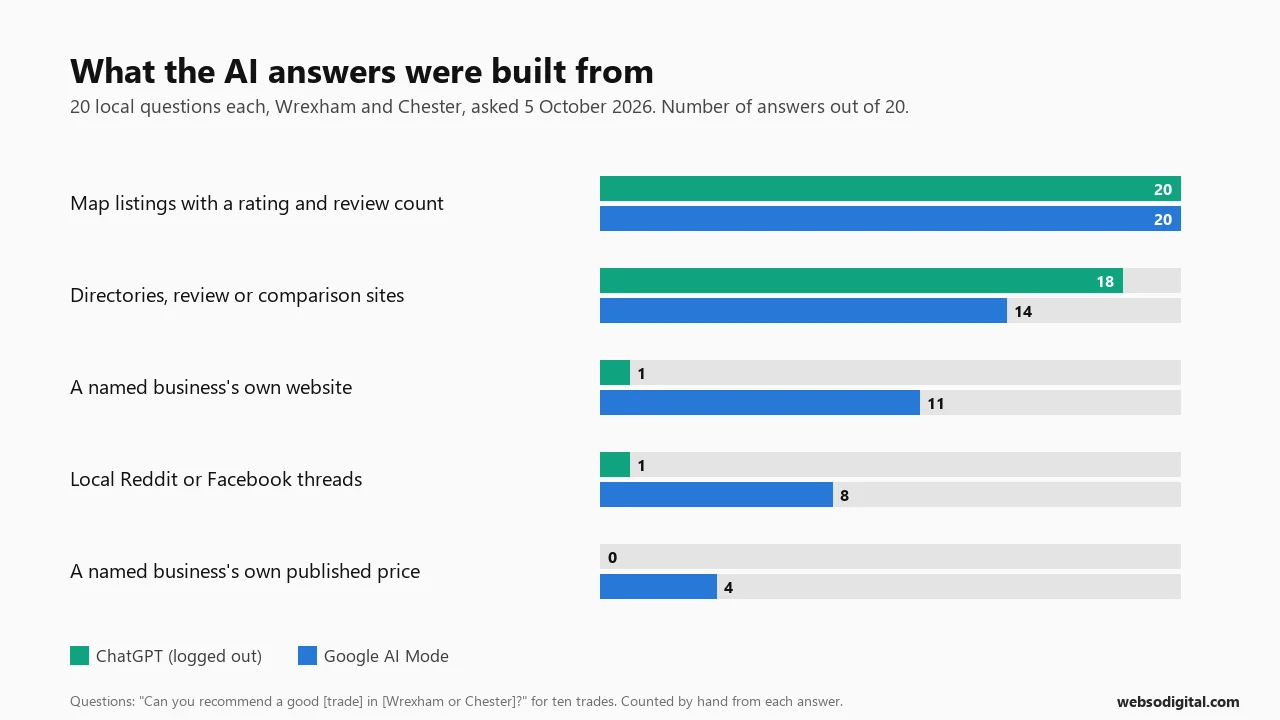
On 5 October 2026 we asked ChatGPT and Google's AI Mode the same 20 questions: "Can you recommend a good [trade] in [town]?" for ten trades, in Wrexham and in Chester. All 40 answers started from the map: a list of local businesses, each with its Google rating and review count. ChatGPT never recommended a business rated below 4.5. Google's AI went lower when the business's own website or local forum posts gave it something specific to say. The biggest difference between the two was the website: ChatGPT drew on a named business's own site in 1 answer out of 20, Google's AI in 11, and it quoted prices straight from four businesses' own pages. The two engines agreed on just over half of the names. For a local firm, that puts three things in order: a well-reviewed map listing first, a website that states plainly what you do, where and for how much second, and real mentions on directories and local forums third.
What we asked, and how
Ten trades people search for every day: plumber, electrician, roofer, builder, dentist, solicitor, accountant, estate agent, car mechanic and removals company. One plain question each, in Wrexham and in Chester, worded the way a customer would type it. ChatGPT was used logged out, with no account and no memory, so nothing about us shaped the answer. Google AI Mode was used in a normal signed-in browser in the UK, so its answers may carry some personalisation; we say so wherever it matters. Each question was asked once, between 1am and 2am. We logged every business named, its rating and review count as the answer showed them, and every source the answer pointed to.
We do not name the businesses in this write-up, apart from one of our own clients further down. The point is the pattern, not a league table, and an answer can change from one day to the next.
Every answer started with the map
All 20 ChatGPT answers and all 20 Google answers opened with map listings: business names, star ratings, review counts, often a street address and opening hours. Between them they named 197 businesses, and only three came without a rating. Whatever else an assistant reads, the shortlist is drawn from businesses that have a Google Business Profile in the town and reviews on it. A business that works from home with no public address, or has an unclaimed profile, starts at a disadvantage; Google's AI did list two mobile mechanics, but found them through a booking platform. We saw the same thing with a mobile remapper last week: KP Tuning is recommended for a longer question but missing from the short one.
Rating mattered more than the review count
ChatGPT's lowest rating across 96 rated recommendations was 4.5, and the middle of the range was 4.9. Google's AI named eight businesses below 4.5, down to 3.0, and in each case it had something specific from elsewhere: an estate agent trading for more than 60 years, a practice locals praise for nervous patients, a remover that belongs to the British Association of Removers.
The number of reviews that counts as plenty depends entirely on the trade. In ChatGPT's answers the typical builder named had 12 reviews, while the typical dentist had 218. Eleven of its recommendations had fewer than 20 reviews, nearly all of them builders and specialist solicitors. So the useful question is not how many reviews you need in general, but how many the businesses already named in your trade and your town have.
- Builders: about 12 reviews (ChatGPT) and 13 (Google)
- Accountants: 65 and 65
- Electricians, roofers, removals, solicitors: roughly 55 to 130
- Plumbers, mechanics, estate agents: roughly 90 to 175
- Dentists: 218 and 146
ChatGPT reads directories. Google's AI reads your website
ChatGPT backed 18 of its 20 answers with directories, review and comparison sites: Checkatrade, Yell, MyBuilder, trade bodies and review platforms for solicitors and dentists. It drew on recommended businesses' own websites in one answer, for two Wrexham removals firms whose services and insurance it described from their sites.
Google's AI did it in 11 of 20 answers. It quoted what businesses say about themselves: accreditations, how long they have traded, who runs the firm, which towns they cover, what they guarantee, and in one case a line about keeping deliberately local. It built comparison tables from those facts. If your website does not say these things plainly, Google's AI has nothing of yours to quote, and it will describe you from your reviews or not at all.
Prices get quoted when you publish them
ChatGPT gave no business's own price in any of the 20 answers; once, for estate agents, it quoted an average fee from a comparison site. Google's AI quoted a named business's own price in 4 answers: hygiene appointments and check-ups from dental practices' own pages in both towns, a removals firm's weekly storage price from its site, and a garage's hourly labour rate from its booking-platform listing. In six answers it also gave a typical price range from a trade directory or comparison site. If you publish a clear starting price, it can be the number a customer sees next to your name. If you do not, they may see someone else's average instead.
Local conversations count for Google's AI
Google's AI quoted local Reddit and Facebook threads in 8 of its 20 answers, usually as a short "what local people say" section, and twice it recommended a business that had very few Google reviews because residents had named it on a community page. ChatGPT drew on local threads once. There is no shortcut here and there should not be one: the businesses that benefited were ones real customers had named unprompted.
The two engines agreed about half the time
On average, 58% of the businesses ChatGPT named for a question also appeared in Google's answer to the same question, and the two picked the same business first 10 times out of 20. Being named by one is not being named by both, so check both.
One we know well: Duffield Removals
Asked for a removals company in Chester, both engines named Duffield Removals first. ChatGPT described it as a particularly strong all-round option with storage too, on the strength of 4.9 stars from 149 Google reviews. Google's AI went further and quoted the Chester removals page we rebuilt for the family and launched a week earlier, on 28 September: the line about using a smaller van for the carry and a larger one where it can park, and planning around the pedestrian zone's delivery hours. It then built its own tips for moving in Chester around that page.
The reviews put Duffield on the list; years of good work earned those. The website decided what the AI said about them, and it said the specific, local, practical thing the page was written to say.
What to do if you run a local business
- Get the map listing right first. The correct category, a real address or service area, accurate hours, and photos. Without it you are not on the list either engine starts from.
- Ask every happy customer for a review, steadily. Aim for the level the businesses already named in your trade and town have, not a number from a blog post.
- Say plainly on your own site what you do, where and for how much. Services, towns covered, accreditations, guarantees, years trading and a starting price, in sentences Google's AI can lift.
- Be on the directories your trade uses, with the same name, address and phone number as your Google profile. ChatGPT leans on them.
- Ask the questions yourself every month, in both engines, logged out where you can. The answer is the measurement.
The limits of this study
It is one run of 20 questions in each engine on one night, so treat the numbers as a snapshot, not a law. Answers change between runs, and Google's AI was used signed in. Perplexity now asks you to sign in before it answers, so it is not included. Counts of sources only include the sources each answer displayed. The full log of all 40 answers is kept, and we will repeat the same questions to see what moves.
If you want to know what ChatGPT and Google's AI say about your business, and what to change so they say more of it, that is our AI search optimisation work. For businesses in our own patch, start with SEO in Wrexham or SEO in Chester, or simply ask us to run your questions.
Questions people ask
- How does ChatGPT choose which local businesses to recommend?
- In our 20 local questions it always started from map listings: businesses with a Google profile in the town, a high rating and a decent number of reviews. The lowest rating it recommended was 4.5. It then backed most answers with directories and review sites such as Checkatrade, Yell and MyBuilder.
- How many Google reviews do I need to be recommended by AI?
- It depends on your trade. The builders ChatGPT named had about 12 reviews in the middle of the range; the dentists had 218. Look at the businesses already named for your trade in your town and aim for their level, with a steady flow rather than a burst.
- Does my website matter if AI uses map listings?
- For Google's AI, a great deal. It drew on recommended businesses' own websites in 11 of 20 answers, quoting accreditations, areas covered, guarantees and prices. ChatGPT did so in 1 of 20. Your website decides what is said about you once you are on the list.
- Should I publish my prices?
- If you can give an honest starting price, yes. Google's AI quoted named businesses' own prices in four answers and gave a directory's typical range in six. A clear from-price on your own page gives it your number rather than someone else's.
- Why do ChatGPT and Google's AI recommend different businesses?
- They read different sources. ChatGPT leaned on directories, Google's AI on businesses' own websites and local forum posts. On average they shared 58% of their names for the same question and agreed on the first pick 10 times out of 20.
Thinking about a new website?
We design and build fast, modern sites that are made to convert, not just to look good. Tell us what you need and we'll come back with a clear plan.
Start a project